
Intraocular Lenses: The Evolution of Modern Cataract Surgery
Cataract surgery is one of the great success stories of modern medicine. Today, replacing a cloudy natural lens with a precisely calculated intraocular lens (IOL) is a routine procedure that can restore clear vision and significantly improve quality of life. But cataract surgery was not always as predictable as it is today.
Before intraocular lenses
A cataract occurs when the natural lens inside the eye becomes cloudy, causing blurred vision, glare and difficulty seeing clearly. Before the development of intraocular lenses, cataract surgery involved removing the cloudy lens but leaving the eye without an artificial replacement.
Patients could see again after the eye healed, but because the natural focusing power of the lens had been removed, they were left with very high levels of long-sightedness. Thick, powerful spectacles or contact lenses were required to compensate for this loss of focusing power.
Although cataract surgery could restore useful sight, the experience was very different from what patients can expect today.
The birth of the intraocular lens
The development of the IOL transformed cataract surgery.
The first successful implantation of an intraocular lens is generally credited to Sir Harold Ridley, a British ophthalmologist, who implanted an artificial lens in 1949. His idea was inspired by observations of small fragments of Perspex remaining in the eyes of injured Second World War pilots without causing the severe inflammation that might have been expected.
Ridley recognised that a carefully designed artificial lens could potentially replace the focusing function of the natural lens. His pioneering work established the foundation for modern IOL surgery.
Over subsequent decades, lens designs, surgical techniques and materials evolved dramatically, making IOL implantation safer, more predictable and increasingly sophisticated.


Modern intraocular lenses
Today's IOLs are small, highly engineered optical devices designed to remain permanently inside the eye. During cataract surgery, the cloudy natural lens is removed and replaced with an IOL selected according to the patient's eye measurements, visual requirements and lifestyle.
Modern lenses are commonly made from foldable acrylic materials, including hydrophobic or hydrophilic acrylic polymers. Their flexibility allows the lens to be inserted through a very small incision before unfolding within the eye.
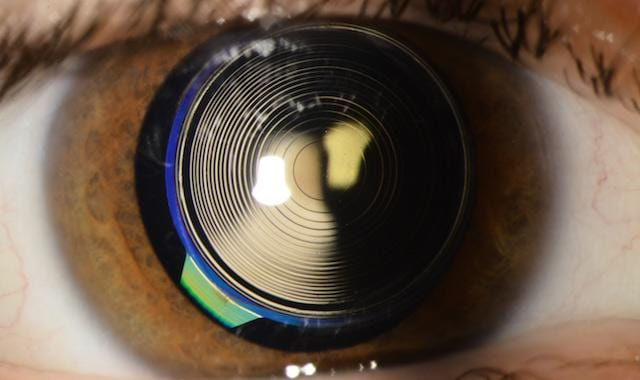
The optical design of modern IOLs has also advanced considerably. Depending on the patient's requirements, options may include:
-
Monofocal IOLs, providing clear vision at one principal distance
-
Toric IOLs, designed to correct suitable levels of corneal astigmatism
-
Multifocal or trifocal IOLs, designed to provide vision across more than one distance
-
Extended-depth-of-focus (EDOF) IOLs, designed to provide an extended range of useful vision
The most sophisticated lens is not necessarily the best lens for every patient. Careful assessment of the eye and an understanding of the patient's visual priorities are essential when selecting an IOL.
How long do IOLs last?
A modern IOL is intended to be a life long permanent implant not needing replacement. Unlike spectacles or contact lenses, it does not normally need routine replacement simply because it has been in the eye for many years.
The lens material is designed to remain stable within the eye, and modern IOLs can provide clear optical function for the remainder of a patient's life.
Occasionally, a patient may require further treatment after cataract surgery. For example, posterior capsule opacification (PCO) can cause vision to become cloudy months or years after surgery. This is not the artificial lens itself becoming cloudy. It can usually be treated quickly and effectively with a YAG laser procedure.
The benefits of modern IOL surgery
Modern cataract surgery combines sophisticated eye measurements, microsurgical techniques and advanced lens technology. It can remove the visual effects of cataract while also addressing existing refractive errors such as short-sightedness, long-sightedness and, with an appropriate toric lens, astigmatism.
For many patients, the result is clearer, brighter and more functional vision, often with substantially less dependence on spectacles.
The journey from removing a cataract and relying on very thick glasses to implanting a precisely calculated lens inside the eye represents one of the remarkable advances in ophthalmology.
Today, cataract surgery is one of the most commonly performed and most successful surgical procedures in the world, with modern IOLs playing a central role in restoring vision and improving patients' quality of life.
LEARN ABOUT MODERN