

Age Related Macular Degeneration: Types of AMD
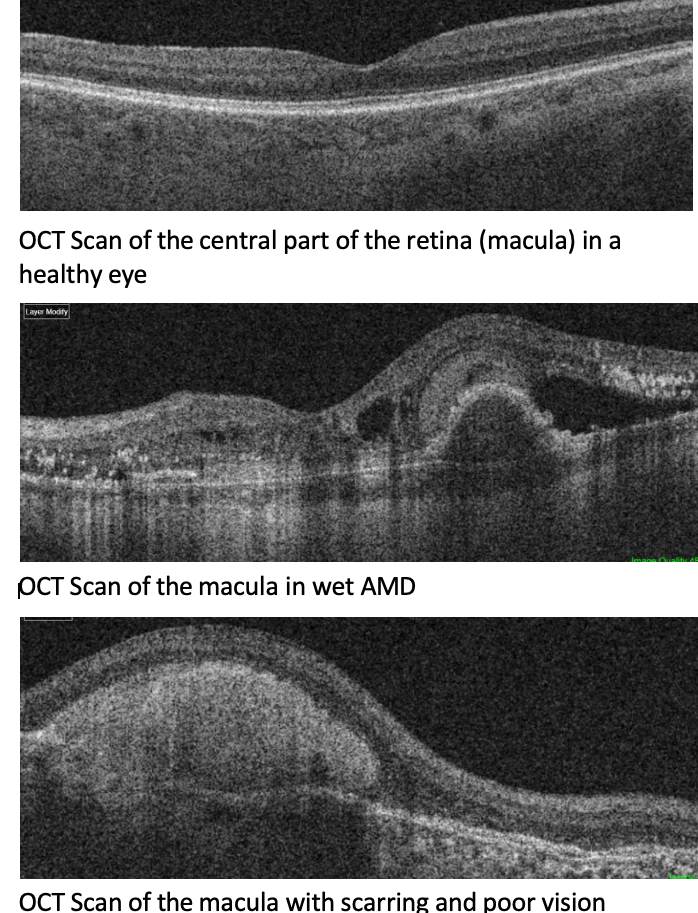
Learn the key differences between Wet AMD and Dry AMD, including symptoms, causes, stages, and treatments. Expert guide to age-related macular degeneration. OCT scans, FAF scans and FFA imaging are crucial tools in the accurate diagnosis.
Age-related macular degeneration (AMD) is a progressive eye condition that affects the macula — the part of the retina responsible for sharp central vision. It is one of the leading causes of vision loss in adults over 50.
AMD does not cause complete blindness, but it can severely impact daily activities such as reading, driving, and recognising faces.
There are two main types:
Dry AMD (non-neovascular)
Wet AMD (neovascular)
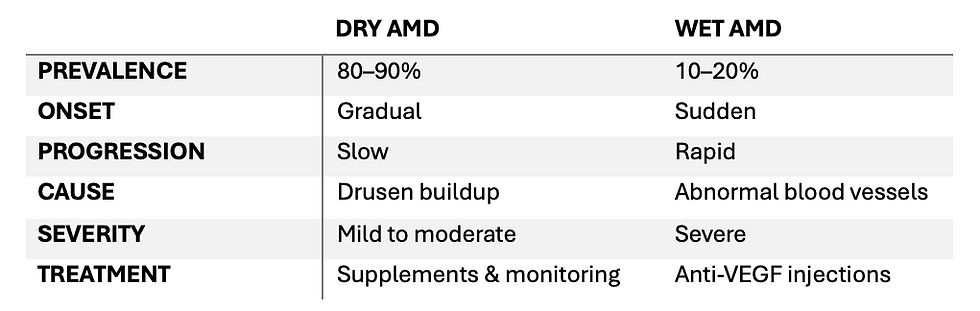
Dry AMD vs Wet AMD: Key Differences
Dry AMD (Most Common Form)
Dry AMD accounts for around 80–90% of cases and progresses slowly over time.
What happens:
Drusen (yellow protein deposits) build up under the retina
The macula gradually thins
Vision becomes increasingly blurred
Symptoms:
Gradual central vision loss
Difficulty reading in dim light
Need for brighter lighting
Mild distortion of vision
Wet AMD (More Severe Form)
Wet AMD is less common but more aggressive and vision-threatening.
What happens:
Abnormal blood vessels grow under the retina
These vessels leak fluid or blood
Rapid damage to the macula occurs
Symptoms:
Sudden central vision loss
Wavy or distorted lines (metamorphopsia)
Dark or blank spots in vision
Rapid deterioration over days or weeks
Both forms of AMD share similar risk factors:
Age (50+ strongest risk factor)
Smoking (major modifiable risk factor)
Genetics / family history
High blood pressure
Obesity
Diet low in antioxidants
Eye care professionals diagnose AMD using:
-
Dilated eye examination
-
Fundus photography
-
Amsler grid testing (home monitoring tool)
Early detection is crucial, especially to prevent progression from dry to wet AMD.

-
Dry AMD Treatment
There is no cure, but progression can often be slowed:
-
AREDS2 supplements (vitamins C, E, zinc, lutein, zeaxanthin)
-
Healthy lifestyle changes (diet, exercise, smoking cessation)
-
Routine eye monitoring
Wet AMD Treatment
Wet AMD requires urgent treatment to prevent permanent vision loss.
Primary treatment:
-
Anti-VEGF injections (first-line therapy)
Other treatments:
-
Photodynamic therapy (select cases)
-
Ongoing retinal monitoring and maintenance therapy
-
Yes. Dry AMD can progress into wet AMD when abnormal blood vessels develop beneath the retina. This is why regular eye exams are essential even if symptoms are mild.
Seek urgent medical attention if you experience:
Sudden blurry central vision
Straight lines appearing wavy
A dark or blank patch in vision
Rapid worsening in one eye
Living With AMD
While AMD affects central vision, many people maintain independence with support tools:
Magnifying devices
High-contrast reading materials
Improved lighting at home
Accessibility settings on digital devices
Low vision rehabilitation services
Frequently Asked Questions (FAQ)
What is worse: wet AMD or dry AMD?
Wet AMD is more severe because it progresses rapidly and can cause sudden vision loss.
Can AMD be cured?
There is no cure, but wet AMD can often be controlled with treatment, and dry AMD progression can be slowed.
How fast does wet AMD progress?
Wet AMD can progress over days or weeks if untreated.
Is AMD hereditary?
Yes, genetics play a significant role, especially in dry AMD.
Can lifestyle changes help AMD?
Yes. Smoking cessation, healthy diet, and regular eye exams can reduce risk and slow progression.
Conclusion
Understanding the difference between wet and dry AMD is essential for early diagnosis and effective treatment. While dry AMD progresses slowly, wet AMD requires urgent intervention to prevent permanent vision loss. Regular eye exams remain the most important step in protecting long-term vision health.
Summary on types of clinically significant AMD
-
Intermediate AMD:Generally corresponds to early AMD with medium/high risk of progression, such as large drusen, reticular pseudodrusen and associated pigmentary abnormalities.
-
Late AMD (indeterminate): Late-stage AMD changes with subretinal/intraretinal fluid but no detectable neovascularisation, or serous PED without neovascularisation.
-
Late AMD (wet active):Neovascular AMD with demonstrable neovascularisation and activity.(WET AMD)
-
Late AMD (dry):Geographic atrophy without neovascular AMD.
-
The RCOphth/NICE classification therefore makes clear that “intermediate AMD” and “late AMD (indeterminate)” describe very different clinical situations.

Specialist AMD Assessment and Monitoring
A diagnosis of Age-related macular degeneration (AMD) does not necessarily mean your vision will deteriorate. However, regular specialist assessment is important because AMD can change gradually, sometimes before you notice any symptoms.
Specialist monitoring allows detailed examination of the macula and tracking of changes over time. This may include vision testing, Amsler grid assessment and retinal imaging such as OCT and, when appropriate, OCT angiography (OCTA). Follow-up can then be tailored to your individual retinal findings and risk factors.
You should also seek prompt assessment if you develop new distortion, waviness, blurred central vision, a dark or missing area, or any sudden change in vision.
Mr Praveen Kumar is Senior Consultant Ophthalmologist is Lead Consultant for AMD services in NHS, provides specialist assessment and monitoring of AMD, with a focus on detailed retinal evaluation and modern imaging. His approach can help provide a clear understanding of your condition, monitor changes over time and identify concerning developments promptly.
Early AMD deserves careful monitoring, not simply reassurance. Regular assessment with a macular specialist provides the surveillance needed to respond appropriately if your condition changes.
