
AMD: FAQs
Age-related macular degeneration (AMD) explained by a retinal specialist. Learn about wet AMD treatment, eye injections, OCT scans, Vabysmo, Eylea HD, and what to expect from care in the UK. Clear answers on vision loss, driving, and treatment frequency.
At present, there is no cure for age-related macular degeneration (AMD). However, this does not mean that nothing can be done.
The outlook depends on the type of AMD. Dry AMD, the more common form, usually progresses slowly over many years. While there is currently no treatment that can reverse the condition, regular monitoring, lifestyle measures, and in selected cases nutritional supplements may help reduce the risk of progression.
Wet AMD is a more aggressive form of the disease but is now highly treatable. Modern anti-VEGF eye injections have transformed outcomes by controlling abnormal blood vessel growth and reducing retinal fluid. Many patients are able to maintain useful vision for reading and daily activities for many years, and some experience improvement following treatment.
The most important factor in preserving vision is early diagnosis and timely treatment. When therapy is started promptly, the likelihood of maintaining long-term sight is significantly improved.
Although AMD cannot currently be cured, it can often be very effectively managed with modern treatments and long-term monitoring. Mr Kumar is reputed leading AMD specialist in Reading, Windsor and surroundings areas of Berkshire who adopts a highly individualised, imaging-led and evidence based scientific approach to macular degeneration care, aiming to preserve vision for as long as possible while minimising treatment burden and optimising long-term outcomes.
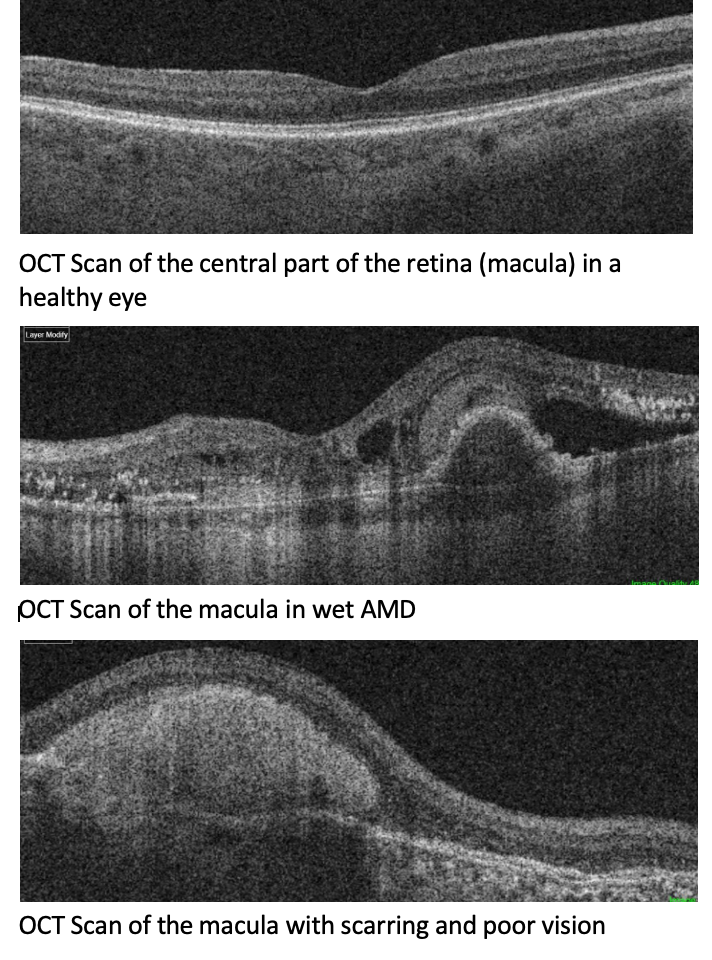
This is one of the most common concerns following a diagnosis of macular degeneration. The reassuring reality is that most people with AMD do not become completely blind. The condition affects the macula, which is responsible for central vision used for reading, recognising faces, and detailed tasks. Peripheral (side) vision is usually preserved.
Without treatment, wet AMD can cause permanent central vision loss, sometimes progressing quickly over weeks or months. Once established, this damage is often irreversible.
However, modern anti-VEGF therapies have significantly changed the prognosis. When treatment is started early and continued appropriately, most patients retain functional central vision, and many maintain independence and quality of life for many years.
Visual outcomes depend on several factors, including disease stage at diagnosis, treatment timing, and individual response. This is why early assessment and ongoing monitoring are essential.
Mr Kumar’s focus is on early detection, timely treatment, and long-term preservation of vision using the most appropriate evidence-based therapies for each individual patient.
The frequency of eye injections for wet AMD varies between individuals, and treatment is always tailored to the patient rather than following a fixed schedule. Treatment usually begins with an initial phase of more frequent injections to control disease activity. Once the retina is stable, the regimen is adjusted according to response.
At Mr Kumar’s clinic in Reading and Windsor, treatment is commonly guided by a Treat-and-Extend approach, an internationally recognised strategy designed to maintain disease control while reducing treatment burden where safely possible.
In practice:
Some patients initially require injections every 4–6 weeks
As stability is achieved, intervals are gradually extended
Many patients progress to 8–12 week intervals.
Mr. Kumar utilises newer therapies that may allow longer intervals up to 20 weeks.
However, response varies, and some patients require ongoing frequent treatment to maintain retinal stability. Treatment decisions are guided by detailed Optical Coherence Tomography (OCT) imaging, which allows even subtle fluid changes to be detected early, often before symptoms occur.
In specialist retinal practice, Mr Kumar places particular emphasis on precise imaging interpretation and long-term treatment planning to ensure each patient receives the minimum effective treatment needed to protect vision.
This is a common concern before starting treatment. Most patients find the procedure much more comfortable than expected. At Mr Kumar’s clinic, careful attention is given to patient comfort, communication, and reassurance at every stage. Each step is clearly explained beforehand, so patients know exactly what to expect.
The eye is fully numbed using anaesthetic drops, which effectively eliminate surface pain. The area is then cleaned with antiseptic solution, and a small device is used to gently keep the eye open. During the injection, patients may feel brief pressure or mild discomfort, but this typically lasts only a few seconds. After treatment, mild irritation, watering, or a gritty sensation is common but usually settles within 24–48 hours. Small floaters or bubbles may also be noticed temporarily.
Significant pain is uncommon. If it occurs or worsens, patients are advised to seek review promptly.
Most patients report that the anticipation is more difficult than the procedure itself.
Mr Kumar’s approach combines precise technique with a strong focus on reassurance, communication, and patient comfort throughout treatment.
The injection itself takes only a few seconds.
Once the eye has been numbed and prepared under sterile conditions, the procedure is completed quickly and precisely. Most patients are surprised by how brief this stage is. However, the full appointment typically takes around 30–60 minutes, as careful assessment and preparation are essential.
A typical visit with your macular degeneration specialist may include:
Vision assessment and symptom review
High-resolution OCT retinal imaging
Clinical review and treatment planning
Preparation with anaesthetic and antiseptic drops
The injection itself
Short observation and aftercare guidance
Mr Kumar places strong emphasis on detailed imaging and careful clinical assessment before each treatment, ensuring injections are given only when clinically appropriate. The overall process is designed to be safe, structured, and tailored to each patient’s condition.
For safety reasons, patients are generally advised not to drive after an eye injection, particularly after their first treatment or if they are unsure how their vision may be affected.
Temporary visual disturbance is common and may be caused by:
-
Anaesthetic or dilating drops
-
A small air bubble in the eye
-
Mild post-procedure blurring
-
Temporary irritation or watering
Even mild changes in vision can affect depth perception and reaction time, so arranging alternative transport is strongly recommended. Most effects are short-lived and typically resolve within a few hours to 24 hours. Patients are usually able to resume normal activities shortly afterwards.
Mr Kumar provides clear, individualised aftercare guidance for each patient, ensuring advice is tailored to their specific treatment and visual status before leaving the clinic.
-
Yes. In most cases, patients may choose to transfer from NHS to private care if appropriate.
Many patients consider this for more flexible scheduling, quicker access to review, or continuity with a named retinal specialist.
If you are already under NHS care for macular degeneration, transfer to private care with Mr Kumar is usually straightforward. Your previous scans, treatment history, and management plan are carefully reviewed to ensure continuity without interruption.
A key advantage is that Mr Kumar works across both NHS and private retinal services. This allows for a consistent, coordinated approach to care, supported by full understanding of your clinical history and imaging.
Where appropriate and with consent, relevant medical records and retinal scans can be reviewed to ensure treatment decisions are fully informed and seamlessly continued.
Care is not restarted unnecessarily; instead, it is continued in a structured, evidence-based manner tailored to the individual.
Yes. In many cases, patients may transition back into NHS care where clinically appropriate. Because Mr Kumar works across both NHS and private retinal services, transitions can often be coordinated smoothly, supporting continuity of care.
The importance of continuity of care
Macular degeneration is a long-term condition requiring ongoing monitoring and timely treatment adjustments. Continuity with a specialist who understands the full history of the condition is particularly valuable.
Mr Kumar ensures that, regardless of setting, treatment history, imaging, and disease response are carefully considered so that care remains consistent and evidence-based.
Whether patients are managed privately, within the NHS, or across both systems, the focus remains on coordinated long-term retinal care with the aim of preserving vision and maintaining stability.
There is no single “best” injection for wet AMD.
All currently used anti-VEGF treatments are effective at controlling abnormal blood vessel growth and preserving vision when used appropriately.
Treatment choice depends on:
Disease pattern and severity
Response to previous therapy
OCT imaging findings
Required treatment frequency
Individual clinical circumstances
Modern treatment options
Established treatments such as aflibercept (Eylea®) and ranibizumab (Lucentis®) remain highly effective. Newer options such as Vabysmo® (faricimab) and Eylea HD® (aflibercept 8 mg) may offer extended dosing intervals in selected patients, although responses vary.
How treatment is chosen
At Mr Kumar’s clinic, treatment decisions are fully individualised. Each patient undergoes detailed assessment using OCT imaging, symptom review, and previous treatment response.
This allows therapy to be precisely matched to disease behaviour rather than following a fixed protocol.
The aim is to select the treatment that provides the most reliable disease control with the least treatment burden over time.
Vabysmo® (faricimab) is a newer anti-VEGF treatment for wet AMD that targets two disease pathways: VEGF-A and Angiopoietin-2 (Ang-2). This dual mechanism may help reduce retinal fluid and extend treatment intervals in suitable patients.
How it differs from older treatments
Unlike earlier therapies that target VEGF-A alone, Vabysmo acts on two pathways involved in vascular leakage and inflammation.
Clinical trials have shown that some patients may achieve:
-
Improved retinal fluid control
-
Stable or improved vision
-
Longer treatment intervals (in selected cases up to 12–16 weeks)
Suitability
Vabysmo may be considered in patients requiring ongoing injections or those with variable response to previous treatments.
Treatment approach
At Mr Kumar’s clinic, Vabysmo is used selectively based on OCT findings, disease activity, and treatment history. Its use is integrated into a personalised, imaging-led treatment strategy designed to optimise long-term visual outcomes.
-
Eylea HD® (aflibercept 8 mg) is a higher-dose formulation of an established anti-VEGF treatment used for wet AMD. It works by blocking VEGF, a protein responsible for abnormal blood vessel growth and leakage in the retina.
How it differs
Eylea HD contains a higher dose of aflibercept, which may provide longer-lasting control in some patients. Clinical studies suggest that some patients may achieve extended treatment intervals of up to 12–16 weeks.
Suitability
It may be considered for patients requiring ongoing injections, particularly where longer dosing intervals may be appropriate.
Clinical approach
At Mr Kumar’s clinic, treatment decisions are based on OCT imaging, disease behaviour, and individual response rather than medication type alone. The aim is to ensure the most effective and sustainable long-term disease control.
Mr Kumar provides specialist macular degeneration and wet AMD treatment for patients across Berkshire in UK, with clinics at Reading and Windsor, including private retinal consultations and OCT-guided eye injection care.
Understanding Long-Term Treatment for Anti-VEGF Therapy
If you’ve been told you need eye injections for wet age-related macular degeneration (Wet Age-Related Macular Degeneration), one of the first questions most patients ask is: “Will I need these injections forever?”
It’s a completely understandable concern. The idea of regular injections into the eye can feel overwhelming at first—but modern treatment is far more flexible and individualised than many people expect.
At our specialist retinal clinic, consultant ophthalmologist Mr Kumar has extensive experience in managing macular degeneration using the latest evidence-based treatments. He reassures patients every day that the goal is always the same: to protect vision while using the least treatment necessary to keep the eye stable.
The short answer: Most patients do not need injections at the same frequency forever, but many do need long-term monitoring and occasional ongoing treatment.
Wet AMD is a chronic eye condition. While it cannot currently be cured, it can usually be controlled extremely well with modern anti-VEGF therapy—often for many years, and in a far more flexible way than patients initially expect.
Why do I need injections in the first place?
Wet AMD occurs when abnormal blood vessels grow under the retina and leak fluid or blood, damaging central vision. These vessels are driven by a protein called VEGF (vascular endothelial growth factor).
Anti-VEGF injections work by blocking this signal, stopping leakage and stabilising the retina.
Common treatments include:
Aflibercept 2mg
Ranibizumab
Faricimab
Eylea HD
Mr Kumar often explains this to patients by comparing it to long-term control of a chronic condition: the disease is not removed, but its damaging activity is effectively switched off with the right treatment.
So… do I need injections forever?
The honest answer is: often long-term, but not always at the same frequency—and sometimes not indefinitely.
Wet AMD is usually a long-term condition. That means the underlying tendency for abnormal blood vessel growth can remain. For this reason, most patients need ongoing monitoring and some level of continued treatment.
However, in Mr Kumar’s experience, treatment patterns are highly variable—and often far more reassuring than patients expect at diagnosis.
1. Early phase: intensive treatment
At the start of treatment, injections are usually more frequent to:
Quickly control active leakage
Protect central vision
Stabilise the retina
This early phase is the most intensive, but also the most important in preserving long-term sight. Mr Kumar’s priority at this stage is to settle the disease quickly and safely, giving the best possible foundation for long-term stability.
2. Maintenance phase: fewer injections over time
Once the eye responds well, most patients move into a maintenance phase.
Using a personalised “treat-and-extend” approach, injection intervals are gradually increased. Many patients progress to:
Every 6–8 weeks
Then 12-16 weeks
In some cases, Mr.Kumar had successes of even longer intervals up to 20 weeks
This means that over time, treatment often becomes significantly less frequent.
For many patients, this is when anxiety around injections reduces dramatically, as stability improves and appointments become more spaced out.
3. Can injections ever stop?
In selected cases, patients may reach a point where the disease becomes inactive and injections can be paused under close specialist supervision.
However, Mr Kumar is careful to explain that:
Wet AMD is usually not cured
The condition can become active again
Regular monitoring remains essential
If reactivation occurs, treatment can be restarted promptly—often before any noticeable change in vision.
This safety-net approach is what allows treatment to be flexible, without compromising long-term vision.
4. Why ongoing monitoring matters
One of the most important advances in modern AMD care is flexibility.
Treatment is no longer a fixed lifelong schedule. Instead, it is guided by detailed retinal imaging (OCT scans), allowing Mr Kumar to:
Adjust treatment intervals safely
Reduce treatment when appropriate
Restart quickly if needed
This ensures decisions are based on objective scan results, not guesswork, giving patients confidence that their care is truly personalised.
What this means for you
If you are starting or continuing anti-VEGF injections, it may help to know:
Treatment is usually most frequent at the beginning
Many patients need fewer injections over time
Vision can often be stabilised long-term
Treatment plans are flexible and fully individualised
Care is guided by specialist retinal assessment at every stage
Mr Kumar’s approach is centred on reassurance, clarity, and long-term planning—so patients always understand what is happening and why.
A note from Mr Kumar
Patients often arrive worried that injections mean an endless cycle of treatment. In reality, many are reassured to learn that modern wet AMD care is highly adaptable.
The goal is not more treatment—it is the right treatment at the right time, to preserve sight for as long as possible while minimising burden.
Worried about injections?
It is completely natural to feel anxious about eye injections. In practice, most patients are surprised by how quick, controlled, and well-tolerated the procedure is.
Mr Kumar and his team prioritise:
Comfort
Safety
Clear communication at every stage
Patients are never rushed, and every step is explained carefully.